Oocyte Activation
Blog
July 13, 2026
 Your location:

July 13, 2026
Navigating the IVF journey in Singapore can feel like a full-time job. Between managing appointments around busy work schedules, tracking hormone injections, and budgeting for cycles, you pour your heart, mind, and resources into every single try.
When a cycle doesn’t result in successful fertilization—especially after using advanced techniques like Intracytoplasmic Sperm Injection (ICSI)—it can be heartbreaking. You find yourself asking: We put the sperm directly into the egg, so why didn’t it fertilize?
Often, the missing link isn’t the quality of your eggs or sperm, but a hidden biological “communication breakdown.” This is where an advanced laboratory technique called Artificial Oocyte Activation (AOA) is helping Singaporean couples bridge the gap to successful embryo development.
To understand how AOA improves your success rates, it helps to look at how nature handles fertilization.
Think of your body’s cells as having a tiny, built-in “on” switch. In a standard conception or typical ICSI cycle, the sperm enters the egg and is supposed to flip that switch. It does this by releasing a specific enzyme that triggers calcium levels to rise and fall in waves inside the egg.
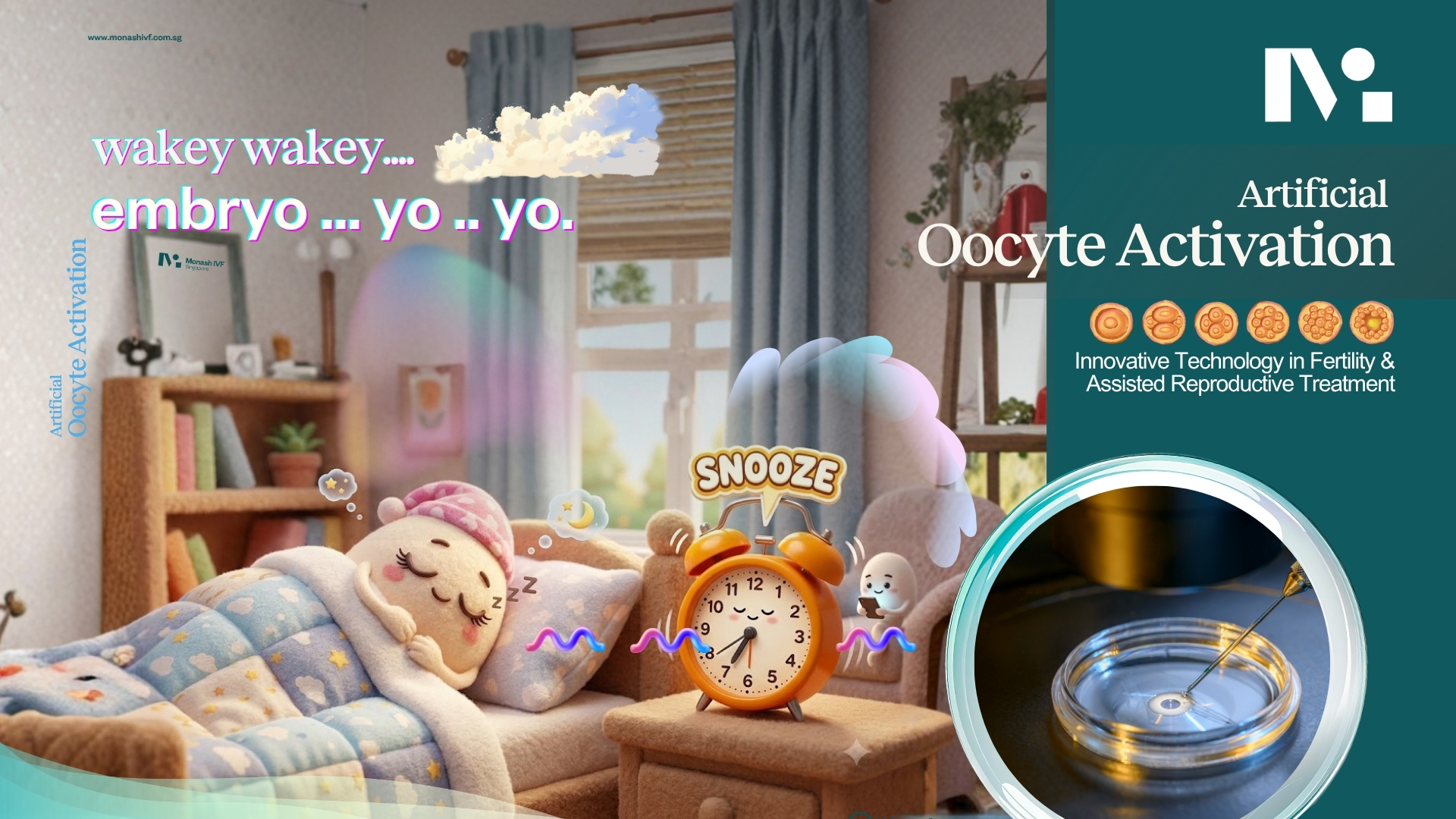
These calcium waves are the ultimate biological alarm clock. They tell the egg: “Wake up, start dividing, and grow into an embryo.”
However, if the sperm lacks this enzyme, or if the egg is a very heavy sleeper and doesn’t register the signal, the calcium waves never happen. The egg stays asleep, and fertilization fails, even though the sperm is physically inside it.
AOA is essentially a gentle, highly precise laboratory jump-start for an egg that needs extra help waking up.
Right after the embryologist performs ICSI, they temporarily introduce the egg to specialized conditions in the lab to mimic nature’s natural alarm clock. In modern fertility clinics, this is typically achieved through three primary methods.
At Monash IVF Singapore, the egg is placed in a specialised culture medium containing calcium ionophores. These act like temporary, microscopic tunnels, allowing a gentle rush of calcium to flow into the egg and trigger the necessary wake-up waves.
AOA is not a routine procedure for every standard IVF cycle, but it is an effective evidence-based add-on for specific situations. Your fertility specialist may recommend AOA if you fall into these categories:
A Quick Reassurance: AOA does not alter the genetic blueprint of your future baby. It simply provides the missing spark to get the biological engine running when nature’s spark plug misfires.
All assisted reproduction procedures at Monash IVF Singapore, including AOA, are performed in accordance with the Singapore Ministry of Health’s guidelines on Assisted Reproduction Technology (ART). These guidelines ensure clinical safety, ethical practice, and consistent standards of care across all licensed ART centres in Singapore.
If you are planning your next IVF cycle and want to maximize your success rates, knowledge is your best advocate.
Monash IVF Singapore stands out for offering exceptional care, proven outcomes, and clear pricing. As part of a globally recognised IVF group, our clinic combines international expertise with leading local fertility specialists.
Book a complimentary chat with our nurse or WhatsApp us today.
No. AOA is a supplementary step used within an IVF cycle alongside ICSI. It is not a standalone fertility treatment. It is an additional laboratory intervention applied to eggs after sperm injection when fertilisation is at risk of failing.
The most common indicator is a history of total fertilisation failure or very low fertilisation rates in a previous ICSI cycle. Your fertility specialist will review your full history including sperm parameters, embryo development records, and any prior diagnostic results before recommending AOA.
Current evidence does not indicate any increased risk. Multiple studies tracking children born after AOA with calcium ionophore have not identified developmental differences compared to those born from standard ICSI. Your specialist will walk you through the full evidence base before proceeding.
AOA significantly improves fertilisation rates in cases where oocyte activation failure is the underlying cause, but it is not a guarantee. Outcomes still depend on egg quality, sperm quality, and other individual factors. Your specialist will set realistic expectations based on your situation.
Citations and References:
